Lore Card
She is one of the very few women in the Hebrew Bible whose love for a man is stated outright, and her father used it as a trap. "And Michal Saul's daughter loved David" (1 Samuel 18:20, KJV). Saul is pleased, because she can be "a snare" to him (18:21).
The legend
The bride-price is a hundred Philistine foreskins. Saul hopes the Philistines will kill the young hero. David brings back two hundred (18:25–27). Michal marries the man her father has started to fear.
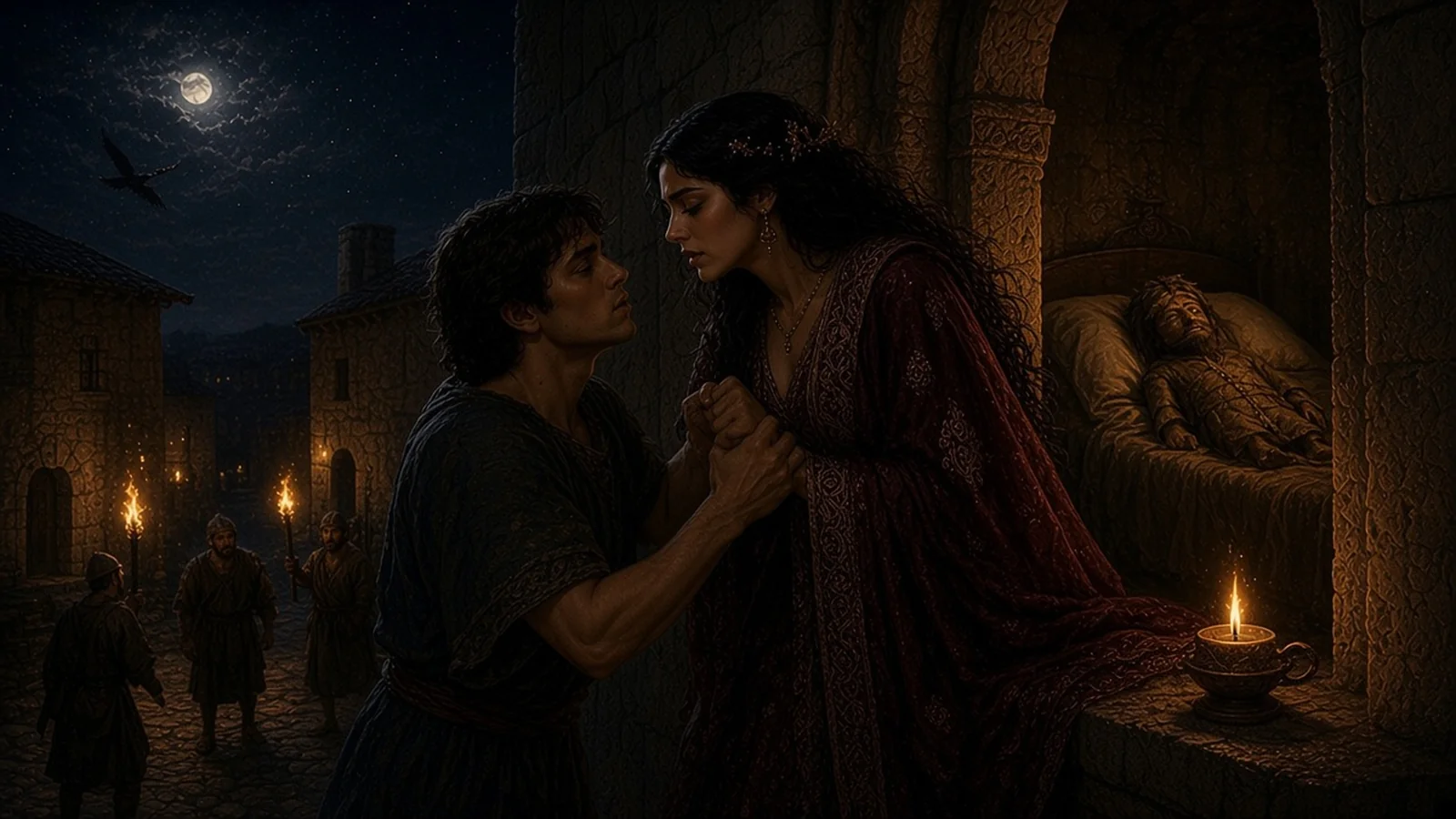
The first window. One night Saul's assassins surround the house. Michal warns David: if you don't escape tonight, you will die tomorrow. "So Michal let David down through a window" (19:12, KJV). She puts the household idol in his bed, covers its head with goat's hair, and tells the soldiers he is sick. When her father confronts her, she lies to him a second time to save herself.
David does not come back for her. Saul gives her to Palti son of Laish (25:44). Years later, while negotiating for the throne, David demands her back as part of the deal. She is taken from her husband, who follows her, weeping, as far as Bahurim, until the general Abner orders him home (2 Samuel 3:13–16).
The second window. When the Ark of the Covenant enters Jerusalem, Michal looks out "through a window, and saw king David leaping and dancing before the LORD; and she despised him in her heart" (2 Samuel 6:16, KJV). They quarrel with cold fury, and he throws her father's fall in her face. The story ends: "Therefore Michal the daughter of Saul had no child unto the day of her death" (6:23).
Versions
- The sword in the bed: The rabbis insist that Palti never touched her. He planted a sword between them (Sanhedrin 19b).
- A woman of law: A baraita records that Michal wore tefillin and the Sages did not object (Eruvin 96a).
What fantasy gets right / what it misses
Gets right: the passion, the rescue, the love triangle, and love turning to contempt.
Misses: The Bible never lets Michal speak of love, or of anything inside her after it. Her tragedy is political: she is traded between three men as a seal on their alliances. Romance gives her the voice the text withholds. That is the real dark-romance appeal, and it should be read as invention, not source.
Note: these books are historical and biblical fiction rather than fantasy. No fantasy novel centered on Michal could be verified.