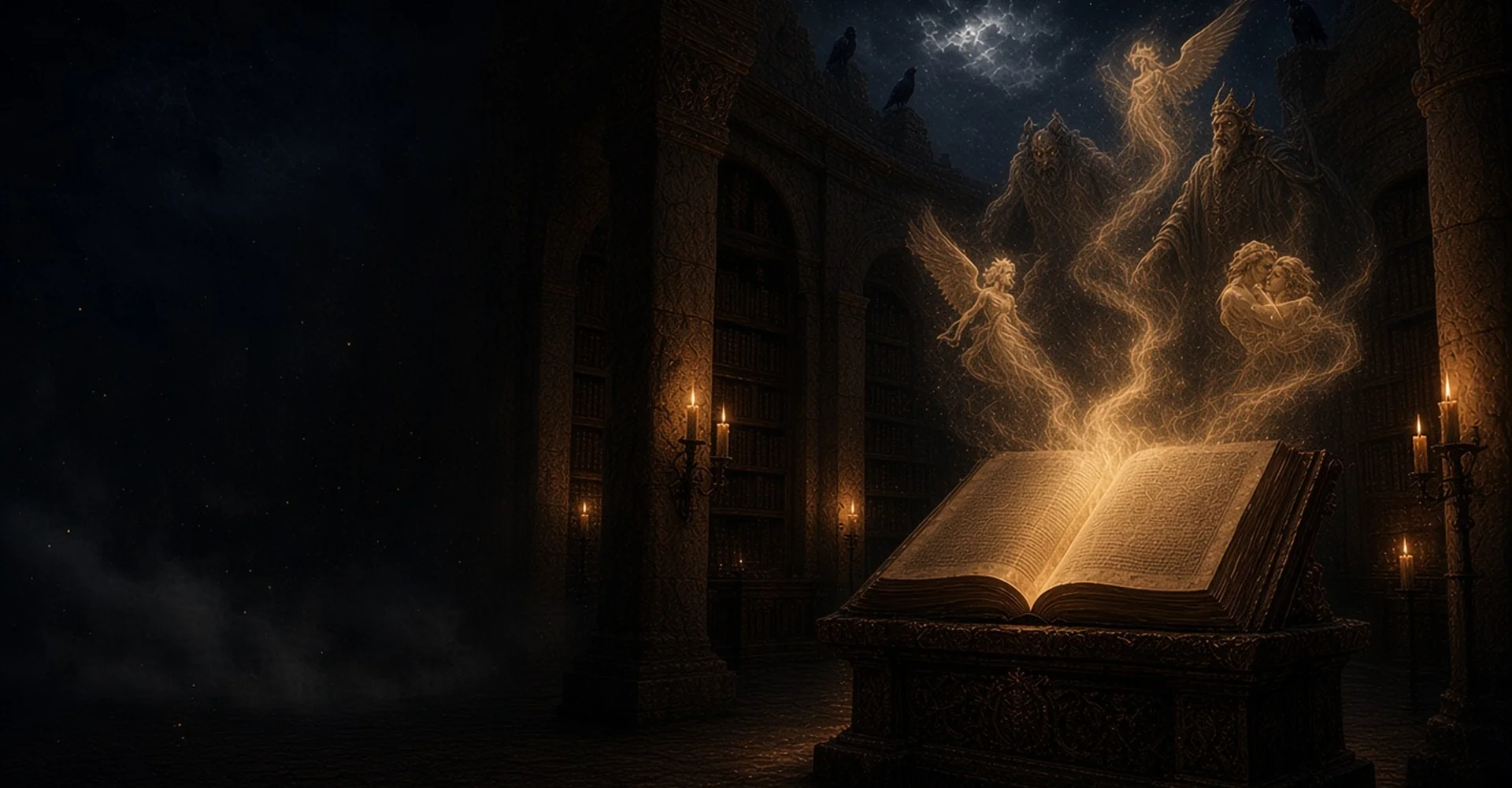
The Mythic Bestiary is a field guide to the creatures fantasy borrowed and seldom credited.
Before the vampire queen, the clay guardian and the winged half-angel there were older texts: a single word in Isaiah, a three-line anecdote in the Talmud, an apocryphal scroll found in fragments by the Dead Sea. This site collects those beginnings, in a storybook voice and with careful footnotes.
What you will find here
- A lore card for every figure. It opens with the hook, then gives the real legend, its versions, and an honest note on what modern fantasy gets right and what it misses.
- Original sources. Key verses appear in Hebrew or Aramaic with an English translation, and every claim points back to its text.
- Books to read next. Real novels and collections that feature each figure, checked before they are listed.
Sources policy
Hebrew and Aramaic quotations, with English, are drawn from the Sefaria API and public-domain editions. For reference and reading we also point to Mechon Mamre and Chabad.org; we do not reproduce their copyrighted texts. Where a translation is CC-BY-NC (for example the William Davidson Talmud), we name the license on the figure page. We never invent quotations. Wherever we quote directly, the translation is named.
Art
The paintings are AI-assisted illustrations guided by the primary texts and by an on-site visual canon brief. Hebrew lettering on the art (for example emet on the golem) is overlaid with real Hebrew fonts installed for the build, not invented glyphs.
Our starting point
We begin with Jewish and biblical legend: a tradition with some of the richest and most-borrowed creatures in Western fantasy, and the one most often stripped of its context. Later entries will cover other traditions beyond the Greek canon.
Book links
Book links are plain search links (Bookshop.org and Amazon search). They are not affiliate links. If that ever changes, this page will say so.
Corrections
Myths are argued over. If we have something wrong, we want to know.