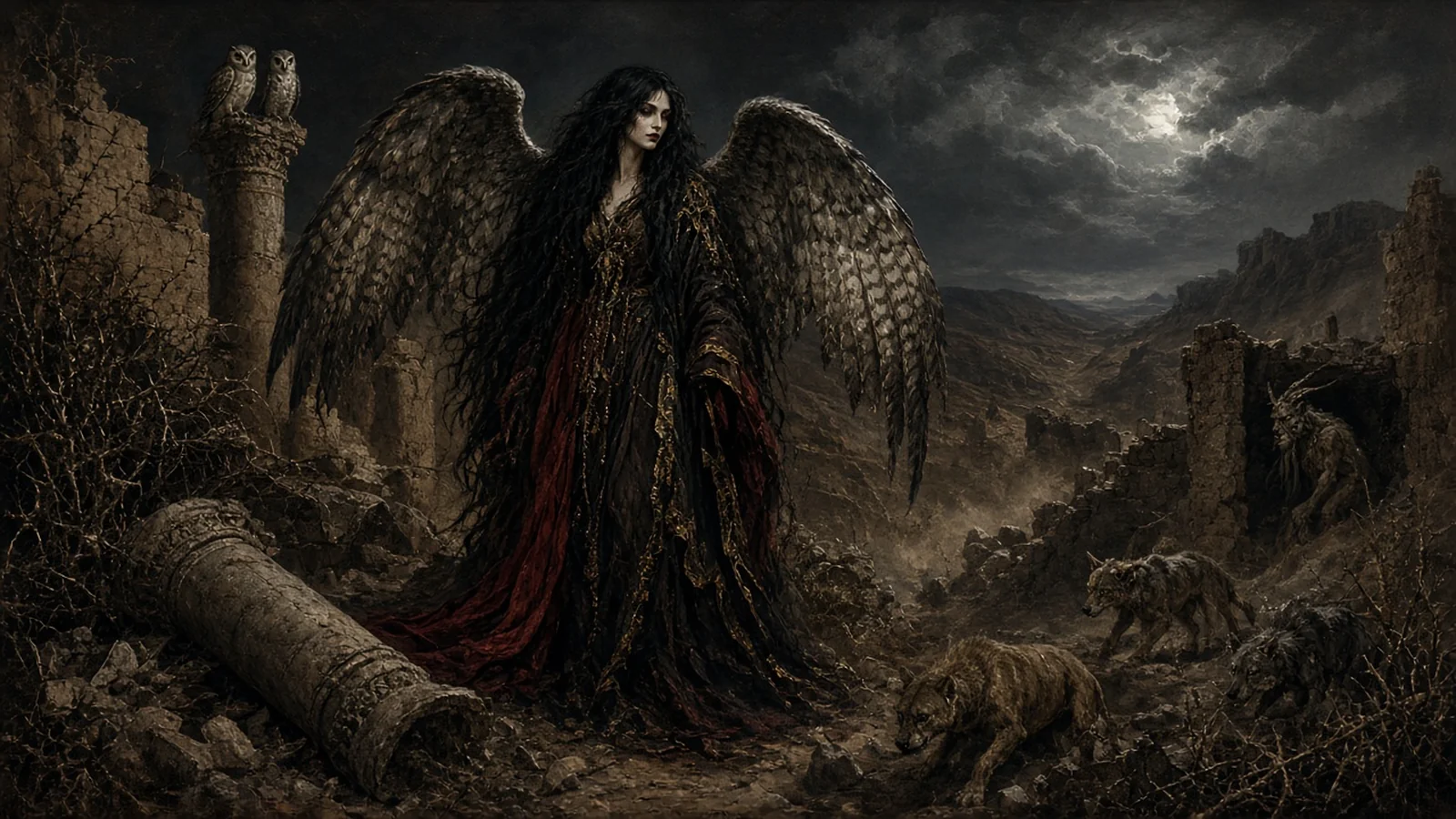
Lilith with long unbound hair and mottled owl-like wings stands among moonlit desert ruins, with owls on a broken column, jackals at her feet, and a horned satyr in the shadows
Hebrew BibleTalmud & MidrashKabbalah & Folk MagicMesopotamian Roots

Lilith

The First Wife, the Night-Hag, the One Who Flew

Art follows Long hair and wings (Eruvin 100b, Niddah 24b); owls, wild-cats, jackals and the satyr of Isaiah 34:14.

Lore Card

Sleep alone in a house, the old warning goes, and she will take you. The Talmud puts it plainly. In Shabbat 151b, Rabbi Hanina says that anyone who sleeps alone in a house will be seized by Lilith. For more than a thousand years, mothers hung amulets over cradles against her.

The legend

Her name appears in the Hebrew Bible exactly once. In Isaiah 34:14, Edom lies in ruins: wildcats meet hyenas, goat-demons call to each other, and the lilith finds a resting place there. Translators have never agreed on what she is. The King James Version made her a "screech owl". Scholars usually link the word to the night-demons of Mesopotamian incantations.

The rabbis knew her better. She has long, wild hair (Eruvin 100b). The lilith-form has wings and a human face (Niddah 24b). She has a son, Hurmin, whom Rabba claimed to have seen running along the battlements of Mehoza (Bava Batra 73a).

The story everyone tells comes much later. It is from the Alphabet of Ben Sira, a strange and often satirical medieval text. God forms Lilith from the earth, just as He formed Adam. When Adam insists that she lie beneath him, she refuses: they were made from the same earth, so they are equals. She speaks the Ineffable Name and flies away. Three angels, Sanoi, Sansanoi and Semangelof, chase her to the sea. She will not return. Instead she makes a bargain: wherever she sees their names or images, she will spare the child. That is why the three names were written on birth amulets.

Versions

  • Late antiquity: Aramaic incantation bowls buried under houses in Mesopotamia bind and banish liliths.
  • Kabbalah: Later mystical texts make her a queen of the demonic realm and consort of Samael.
  • Modernity: Jewish feminists reclaimed her as the woman who would not submit. The magazine Lilith took her name in 1976.

What fantasy gets right / what it misses

Gets right: the refusal, the wings and the hair, her hold on the night, the danger to newborns, and the bargain struck with the angels.

Misses: In the oldest layers she is not a seductive queen. She is a household menace, someone you protect a cradle against. The "first wife" tale is medieval, and its source reads partly as parody. The defiant feminist heroine is a modern reading. That reading is powerful, but it is modern, and the original is stranger and more frightening.

Original Sources

The key verses in the original Hebrew or Aramaic, with an English translation. Fetched from the Sefaria API.

Isaiah 34:14 ישעיהו ל״ד:י״ד

The only biblical lilith

וּפָגְשׁ֤וּ צִיִּים֙ אֶת־אִיִּ֔ים וְשָׂעִ֖יר עַל־רֵעֵ֣הוּ יִקְרָ֑א אַךְ־שָׁם֙ הִרְגִּ֣יעָה לִּילִ֔ית וּמָצְאָ֥ה לָ֖הּ מָנֽוֹחַ׃
And the wild-cats shall meet with the jackals, And the satyr shall cry to his fellow; Yea, the night-monster shall repose there, And shall find her a place of rest.

JPS 1917 renders לִּילִית as “night-monster”.

Hebrew: Miqra according to the Masorah (CC-BY-SA)English: The Holy Scriptures: A New Translation (JPS 1917) (Public Domain)

Shabbat 151b:10 שבת קנ״א ב:י׳

Do not sleep alone in a house

… אָמַר רַבִּי חֲנִינָא: אָסוּר לִישַׁן בַּבַּיִת יְחִידִי, וְכׇל הַיָּשֵׁן בַּבַּיִת יְחִידִי — אֹחַזְתּוֹ לִילִית.
… Rabbi Ḥanina said: It is prohibited to sleep alone in a house, and anyone who sleeps alone in a house will be seized by the evil spirit Lilith.

Hebrew: William Davidson Edition - Vocalized Aramaic (CC-BY-NC)English: William Davidson Edition - English (CC-BY-NC)

Niddah 24b:10 נדה כ״ד ב:י׳

A lilith has wings (and a human face, per the translation's gloss)

אָמַר רַב יְהוּדָה אָמַר שְׁמוּאֵל: הַמַּפֶּלֶת דְּמוּת לִילִית, אִמּוֹ טְמֵאָה לֵידָה, וָלָד הוּא אֶלָּא שֶׁיֵּשׁ לוֹ כְּנָפַיִם. …
§ Rav Yehuda says that Shmuel says: In the case of a woman who discharges a fetus that has the form of a lilith, a female demon with wings and a human face, its mother is impure with the impurity of a woman after childbirth, as it is a viable offspring, only it has wings. …

Hebrew: William Davidson Edition - Vocalized Aramaic (CC-BY-NC)English: William Davidson Edition - English (CC-BY-NC)

Eruvin 100b:26 עירובין ק׳ ב:כ״ו

Long hair “like Lilit”

בְּמַתְנִיתָא תָּנָא: מְגַדֶּלֶת שֵׂעָר כְּלִילִית, וְיוֹשֶׁבֶת וּמַשְׁתֶּנֶת מַיִם כִּבְהֵמָה, וְנַעֲשֵׂית כַּר לְבַעְלָהּ.
It was taught in a baraita that the three additional curses are: She grows her hair long like Lilit, a demon; she sits and urinates, like an animal; and serves as a pillow for her husband during relations.

Hebrew: William Davidson Edition - Vocalized Aramaic (CC-BY-NC)English: William Davidson Edition - English (CC-BY-NC)

Bava Batra 73a:11 בבא בתרא ע״ג א:י״א

Hurmin, son of Lilith

אָמַר רַבָּה: לְדִידִי חֲזֵי לִי הוּרְמִין בַּר לִילִית, כִּי קָא רָהֵיט אַקּוּפְיָא דְּשׁוּרָא דְמָחוֹזָא, וְרָהֵיט פָּרָשָׁא כִּי רְכִיב חֵיוְתָא מִתַּתָּאֵיהּ, וְלָא יָכֵיל לֵיהּ. …
§ Rabba said: I have seen the one called Hurmin, son of Lilith, when he was running on the pinnacles of the wall of the city of Meḥoza, and a horseman was riding an animal below him but was unable to catch up to him. …

Hebrew: William Davidson Edition - Vocalized Aramaic (CC-BY-NC)English: William Davidson Edition - English (CC-BY-NC)

Interpretations

Classic commentators and translators on the same passages.

Rashi on Isaiah 34:14:4 רש"י על ישעיהו ל״ד:י״ד:ד׳

Rashi: a she-demon

לִּילִית. שֵׁם שֵׁדָה:
lilith The name of a female demon.

Hebrew: Vocalized Edition (CC0)English: The Judaica Press complete Tanach with Rashi, translated by A. J. Rosenberg (CC-BY)

Ibn Ezra on Isaiah 34:14:5 אבן עזרא על ישעיהו ל״ד:י״ד:ה׳

Ibn Ezra: a night bird

לילית. העוף שיעוף בלילה:
לילית The screech owl. A bird that flies abroad by night.

Hebrew: Ibn Ezra on Isaiah, by M. Friedlander; Society of Hebrew Literature, London 1877 (Public Domain)English: Commentary of Ibn Ezra on Isaiah - trans. by M. Friedlander, 1873 (Public Domain)

Texts & licenses
  • Miqra according to the Masorah: CC-BY-SA
  • The Holy Scriptures: A New Translation (JPS 1917): Public Domain
  • William Davidson Edition - Vocalized Aramaic: CC-BY-NC
  • William Davidson Edition - English: CC-BY-NC
  • Vocalized Edition: CC0
  • The Judaica Press complete Tanach with Rashi, translated by A. J. Rosenberg: CC-BY
  • Ibn Ezra on Isaiah, by M. Friedlander; Society of Hebrew Literature, London 1877: Public Domain
  • Commentary of Ibn Ezra on Isaiah - trans. by M. Friedlander, 1873: Public Domain

The William Davidson Talmud (Koren/Steinsaltz) is © Koren Publishers, CC-BY-NC, courtesy of Sefaria. Its English weaves Rabbi Steinsaltz's explanatory additions into the literal translation. JPS 1917 and the Charles Enoch are public domain. Mechon Mamre and Chabad.org are linked for reference only; their texts are not reproduced.

Fantasy Books Featuring Lilith

Buy links are plain search links (not affiliate).